

Acoustics for Outdoor Venues
By Jeffrey E. Babich, INCE Bd. Cert.
Outdoor venues bring people together for the things communities love most like sporting events, summer concerts, graduations, and festivals. But the same events that energize a crowd can generate sound that carries far beyond the property line. Managing that sound well is what separates a venue that neighbors tolerate from one they actively welcome.
Community noise codes are the core of the community involvement that turns a proposed venue into a welcomed one. A clear code gives neighbors confidence, gives operators a defined target, and gives everyone a shared standard to point to when questions arise. The strongest codes address curfews or cut-off times when events should end, support noise surveys that document existing conditions, and verify performance once a venue is operating. Noise modeling during design is recommended so that predicted levels at nearby properties are known before construction.
BABICHacoustics has worked with communities to address changes to noise codes that are complex or outdated. We have also worked with developers and stakeholders during design to ensure that the venue will meet the noise code and the expectations of the community. The best noise codes are simple and have clearly defined decibel limits that are easy to understand, measure, and enforce.
Outdoor vs. Indoor Acoustics

Walls, ceilings, and interior finishes let designers shape sound with reflection and absorption inside buildings. Most sound control disappears outdoors because sound radiates into open air. The main factors shaping how noise travels are distance, ground surfaces, wind, temperature gradients, and terrain.
For a point source such as a loudspeaker in a free field, sound is typically reduced by roughly 6 decibels each time the distance doubles. The noise level of line sources such as a busy roadway are reduced by approximately 3 decibels per doubling of distance. This is impacted by environmental factors such as wind speed, temperature inversions, and ground effects.
In Western Pennsylvania with rolling hills and river valleys, sound propagation can be impacted by a noise source in a valley with noise sensitive areas on hillsides. Because many physical variables are outside the Design Team’s control, outdoor noise control relies heavily on predictive modeling, measurement, and setting realistic expectations.
Athletic Fields: Sources & Strategies

Athletic fields produce a broad mix of sound: crowd noise, whistles, bands, buzzers, and public address (PA) or sound reinforcement systems. Of these, the PA and any amplified music are usually the most controllable as well as the reasons for complaints.
Loudspeaker aiming and directivity are the single most effective tools. Orientation and siting also help. Positioning the field so that the main sound projection points away from the nearest homes and placing press boxes between the source and sensitive receivers can reduce noise levels at the receiver locations.
Sound level management and time limits are the best way to operate the venue. Setting maximum output levels, using automatic limiters, and honoring curfews keep events in check. Many jurisdictions apply stricter limits at night, typically after 10 or 11 PM, so scheduling is key. A plan for traffic into and out of the venue as well as post event crowd control is also crucial for the venue’s success.
Barriers and berms provide limited noise reduction. An earthen berm or solid barrier can help to reduce higher-frequency content and for homes close to the barrier, but low-frequency bass energy diffracts around and over obstacles and is difficult to reduce outdoors.
Ampthitheaters: Designing for the Audience and Neighbors
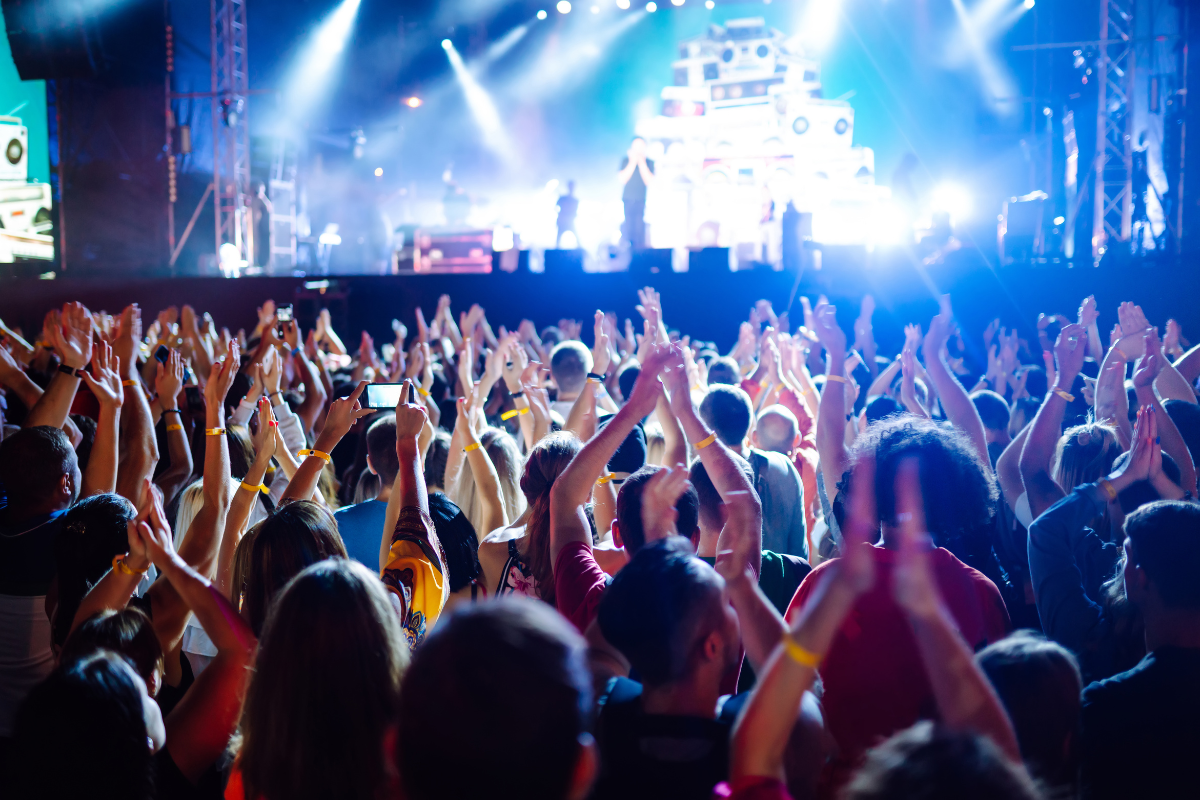
Amphitheaters add a layer of complexity because sound quality for the audience is the primary goal. The design must deliver an excellent experience inside the venue while containing energy to reduce noise impact on the nearby community.
Natural and built amphitheaters often use sloped seating so that each row has a clearer line of sight and sound path to the stage. A raised stage and a reflective shell or canopy behind and above performers project sound toward the audience and improve clarity and loudness where it is wanted. The goal is to provide sound energy and early reflections to listeners without creating distracting reflections or echoes from hard surfaces located farther from the stage. For amplified venues, line-array loudspeaker systems are frequently used because their directivity can be tuned to cover tiered seating evenly while limiting how much energy escapes upward and outward.
The features that make an acoustically superior amphitheater can also help contain sound with an appropriate site design. Berms and surrounding landforms that form the audience area double as barriers. If possible, orienting the open side of the venue away from residential areas keeps the main sound transmission path pointed at open land, water, or commercial buffers.
Low-frequency energy remains the most difficult challenge. Subwoofers radiate long wavelengths that travel far and bend around barriers, and they are a frequent source of complaints. Subwoofer design and placement are increasingly used to reduce the noise impact toward neighbors while preserving impact for the audience.
Measuring and Regulating Outdoor Noise
Effective noise control depends on accurate acoustical measurements. Most communities regulate noise through local ordinances that set limits at the property line or at the nearest residence, often with different daytime and nighttime thresholds. These are typically written in terms of dBA level, which closely approximates the human hearing curves. Because outdoor levels frequently fluctuate, especially during live events, compliance is usually assessed with predictive modeling during design and on-site monitoring during events.
Conclusion
Outdoor acoustics is a balancing act: delivering an immersive, high-quality experience to a crowd while keeping sound from becoming a burden to the surrounding community. Athletic fields require clear, controlled speech, and program audio with careful sound level management. Amphitheaters demand refined sound shaping for the audience alongside containment to meet community demands. In both cases, the best results come from addressing acoustics early in the design process, taking low-frequency noise seriously, and combining the architectural design with operational practices.